Kairomones and the Hidden Chemistry of Fear
- Vicky Ell
- Oct 28, 2025
- 12 min read

In the aquarium world, stress is often thought of in visible terms: aggressive tankmates, cramped quarters, or poor water quality. Yet fish experience a more subtle form of pressure that cannot be observed directly. Without a chase or a single fin torn, an entire shoal can become anxious, subdued, and withdrawn. The cause may be nothing more than a faint trace of chemistry in the water, an unseen predator they can smell but never see.

These chemical signals, known as kairomones, act as a kind of silent language between predator and prey. They allow fish to sense danger before it becomes visible, giving them precious time to react and escape danger. The mechanism works exactly as evolution intended. In aquaria, however, it can become a source of chronic stress when predators and prey share the same water.
This article hopes to help keepers understand these cues and create environments that support genuine welfare rather than constant vigilance.
What are kairomones?

Kairomones are invisible chemical signals that drift silently through the water. Released by one species and detected by another, they give prey an early warning that danger is near, often long before the predator comes into sight.
This ability forms part of an ancient communication system that has shaped underwater life for millions of years.
Research over the past two decades has shown that many predators, from perch to cichlids, shed trace compounds in their mucus, faeces, and metabolic waste that prey can detect at astonishingly low concentrations. These odours drift through the water like invisible messages, and even the faintest traces can provoke dramatic changes in behaviour. Some fish freeze or dive for cover; others stop feeding or exploring. Shoaling species often tighten formation, each fish seeking safety in numbers.
To understand why fish evolved to read these chemical signals so precisely, we need to look back at how this sensitivity first developed in nature.
Why fish evolved to detect kairomones
The ability to detect a predator’s scent is one of the oldest survival skills in aquatic life. Underwater, vision fades quickly with distance, light, and depth, and sound carries poorly across short ranges. Chemistry fills that gap. Chemical signals spread through the water, slow to fade and impossible to hide, giving fish a way to sense danger that is both immediate and reliable.

Over millions of years, natural selection favoured individuals that could recognise these odours. Fish with keener chemical senses were more likely to survive an ambush and pass their sensitivity on. Gradually, the pathways linking scent detection to the stress response became hardwired. Even a faint trace of predator odour can activate a cascade of physiological changes that prepare the fish to react.
This sensitivity also benefits the group. Fish that detect predator scent first can alert others through subtle behavioural cues or chemical alarm signals, allowing the shoal to react as one. The result is a shared awareness: an ancient, collective intelligence that still governs much of life beneath the surface.
How fish detect chemical risk
Fish live in a world shaped by scent. Their sense of smell is extraordinary, far more sensitive than ours. Inside the olfactory epithelium, thousands of microscopic receptors detect amino acids, bile acids, and other molecules released by food, companions, and predators. These signals travel to the brain, where they are interpreted and translated into behaviour.

Experience also shapes how fish respond to threats. Individuals who have lived in the wild or previously faced predators tend to react faster and more intensely than those raised in complete safety. Even fish bred for many generations in captivity can still recognise danger through smell alone. Studies on zebrafish (Danio rerio) and fathead minnow (Pimephales promelas) show that the scent of a predator, without any visual or physical cue, can cause them to freeze, avoid open areas, or stop exploring.
Fish evolved in one region may not immediately recognise the scent of predators from another. Their reactions are tuned to the chemical signatures they have encountered over generations. However, they can learn to recognise unfamiliar threats when these new odours are paired with alarm cues. Once learned, the memory of danger can persist for weeks or even months.
This ability to combine instinct with experience makes their chemical awareness remarkably sophisticated. It also means that predator scent in an aquarium never goes unnoticed. Fish interpret kairomones as evidence of danger, even if no attack occurs. The result is a constant vigilance that the keeper may not see, but the fish continually feels.
In nature, water flow dilutes these scents. Predators move, prey scatter, and the chemical signals fade. In a closed aquarium system, they accumulate. Kairomones released in one tank can travel through pipes, sumps, and filters to reach others, carrying the “smell of danger” far beyond its source.

Public aquaria, fish shops, and even private fishrooms have seen the effects first-hand: prey fish kept on shared filtration loops may appear healthy at first but gradually become withdrawn, dull in colour, and prone to infection. Once separated from predator tanks, they often recover, revealing that the problem lay not in water chemistry, but in chemistry of a different kind.
How fish respond to stress

When a fish senses danger, its entire physiology changes within seconds. The body shifts from maintenance mode to survival mode. This process is controlled by the hypothalamus–pituitary–interrenal axis, or HPI for short, otherwise known as the "fight or flight system".
It works alongside another fast pathway that releases adrenaline and noradrenaline, increasing heart rate and respiration to boost oxygen supply to the muscles. At the same time, the HPI axis releases the hormone cortisol into the bloodstream.
Short bursts of these hormones are adaptive. They free up stored energy, sharpen reflexes, and prepare the fish to flee or hide. In the wild, these hormones spike and fade quickly once the threat passes. In aquariums, they often do not. When predator scent or alarm chemistry lingers in the water and doesn't go away, cortisol levels can stay high indefinitely, keeping the fish in a state of alert that never fully resolves.
As stress continues, the effects spread through the body. Cortisol changes how energy is used, diverting it away from growth and digestion. It also disrupts osmoregulation - the balance of salts and fluids that keeps cells stable - and weakens the immune system, leaving the fish more vulnerable to infection. Appetite declines, wounds heal slowly, and behaviour becomes subdued. In fry, chronic stress can even alter brain development, creating adults who are hyper-reactive to future disturbance.
These changes form what scientists describe as primary, secondary, and tertiary stress responses. The first involves hormone release, the second affects internal chemistry, and the third appears as visible signs of ill-health: slower growth, poor reproduction, or disease. In short, the biology of fear always comes at a cost.
This pattern has been documented across many species.
Tilapia kept under constant disturbance grow slowly and digest food inefficiently. Damselfish mothers exposed to repeated threats produce smaller, weaker larvae. Similar results are seen in zebrafish and trout, where prolonged activation of the HPI axis leads to fatigue and reduced survival. Whether tropical or temperate, captive or wild, the outcome is the same: when stress cannot subside, health and vitality begin to erode.
Today, researchers can measure this strain without harming the fish. Small amounts of cortisol pass across the gills and into the water, allowing stress to be monitored through simple samples. The same hormone can also be found in skin mucus, providing a non-invasive way to assess welfare. These methods reveal just how powerfully invisible chemical cues shape life in captivity: and how easily a tank that looks calm to us can conceal an animal living in constant survival mode.
The welfare implications of mixed predator–prey systems
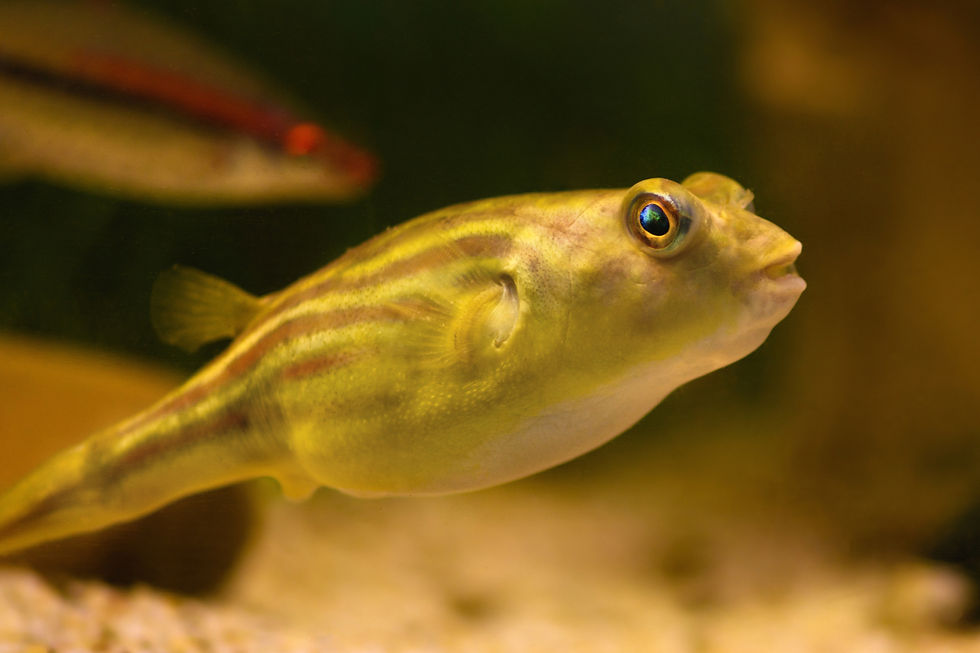
In aquariums, many keepers choose to house predatory fish alongside smaller species. A large Fahaka puffer, for instance, might share its tank with a group of schooling fish. When no attacks occur, it is easy to see this as a balance: proof that predator and prey can coexist.
Yet welfare is not measured by survival alone. A fish that lives in fear is not thriving.
Prey fish do not need to be chased or bitten to feel threatened. The scent of a predator is often enough to activate the body’s stress response. Predators release kairomones in mucus, faeces, and waste, and prey detect these cues even at trace levels. They may continue to swim and feed, but beneath that apparent calm, their bodies are locked in vigilance. In the wild, the scent would fade as the water flows and the predator moves on. In a tank, it lingers, recycled through filters and reinforced with every breath the prey take.
As this continues, the cost becomes visible. Energy once used for growth and immunity is diverted into constant readiness. Appetite fades, colour dulls, and healing slows. The fish survives, but no longer thrives.
The chemistry does not flow in one direction. Fish under stress release cortisol and other metabolites into the water through their gills, mucus, and waste. These compounds can influence nearby fish, creating a shared chemical environment where tension spreads beyond those that first experienced it. While cortisol is a measurable part of this mixture, researchers believe that several other compounds, including bile acids and nitrogenous metabolites, also contribute to this chemical contagion.
Even the predator is not untouched. A Fahaka that seems calm may, over time, absorb the chemical traces of its companions’ fear. In practice, many keepers notice that Fahakas kept with smaller fish become withdrawn, less interactive, and less responsive to their environment. Prolonged exposure to stress-laden water can lead to restlessness, loss of appetite, or a quiet detachment from normal behaviour. Studies in aquaculture and laboratory systems show that stress-related hormones and metabolites can accumulate and alter behaviour when water exchange is limited.

In shared filtration systems, these effects reach even further. Kairomones and stress metabolites travel through pipes and sumps, carrying unease between tanks that never share a sight line. The result is a background tension that no water test can reveal, an invisible network of fear sustained by the chemistry of the system itself.
What looks like peace may, in truth, be quiet distress on both sides. The prey live in constant anticipation of danger, while the predator inhabits water coloured by its neighbours’ anxiety. True balance is not the absence of conflict but the presence of confidence. A healthy aquarium is one where fish feed, rest, and explore without fear.
What good welfare really means
The biology of fear is not just a scientific curiosity. It challenges the way we define good fishkeeping. Clear water and apparent calm can mask quiet distress, and welfare cannot be measured by survival alone.

Modern animal welfare science recognises that well-being extends beyond the absence of harm. The internationally recognised Five Freedoms describe what all captive animals should have: freedom from hunger and thirst, discomfort, pain or distress, fear, and the freedom to behave naturally. When fish are kept in environments that sustain chemical tension, at least two of these freedoms, freedom from fear and the ability to behave normally, are compromised.
This understanding places responsibility squarely on the keeper. It reminds us that fish experience their world chemically as much as visually. Every scent and trace compound forms part of their sensory environment. Managing water quality is therefore not only a technical duty but an ethical one.
For aquarists, success should not mean simply keeping fish alive. It should mean providing a space where they can display calm, curiosity, and natural behaviour, a sign that they are not merely enduring their surroundings but thriving within them.
Practical steps to improve welfare
Responsible aquarists can take several measures to minimise chemical stress and improve welfare outcomes for all species involved. Small changes in system design and husbandry can make a measurable difference to how fish behave and feel.
Avoid long-term predator–prey mixes. Even when no physical aggression occurs, the chemical dialogue between predator and prey continues. Kairomones and alarm cues keep the prey in a state of alertness and can unsettle the predator in return. Mixed displays may look peaceful but often rely on tension rather than trust. Wherever possible, keep predatory and prey species in separate systems, or divide the aquarium in a way that blocks water exchange. Retailers and public aquaria should pay particular attention to system design. Many operate shared filtration loops that connect multiple tanks, often linking large predatory species with smaller display fish. Although convenient for maintenance, this approach allows chemical cues and stress metabolites to circulate freely between enclosures. Predators and prey may never see each other, yet still experience each other's scent. Running separate loops for predatory and non-predatory species, or adding dedicated chemical filtration such as activated carbon or ozone, greatly reduces cross-contamination and improves welfare across the system.
Monitor for subtle signs of stress. Chronic anxiety does not always look dramatic. Dull colouration, reduced feeding, repeated hiding, or tight schooling behaviour may all indicate unease. Learn the normal rhythms of each species and watch for small shifts. A fish that interacts confidently with its surroundings is usually a healthy one.
Educate and reframe success. A thriving aquarium is not defined by the absence of aggression, but by the presence of relaxed, natural behaviour. Respiration should be steady, colours bright, and movement fluid. Share this understanding with other keepers. Helping more people see welfare through behaviour, not just survival, is one of the most meaningful ways to improve standards across the hobby.
Review husbandry through a welfare lens. Every decision about stocking, filtration, lighting, and feeding influences the chemical and emotional landscape of a tank. Periodically review setups with welfare in mind. Ask not only “Are they alive?” but “Do they seem at ease?”
Author's notes:
This article was co-written by Vicky Ell and Macauley Sykes, building on Vicky’s 2014 essay on fish stress and communication, updated with new research and expanded analysis for Pufferfish Enthusiasts Worldwide. It was written to encourage a deeper awareness of the unseen forces that shape life in captivity.
As keepers, we learn to read the language of behaviour and water chemistry, yet the chemical signals that pass silently between fish often go unnoticed. Understanding kairomones and the biology of stress is not about removing risk or creating sterile environments. It is about empathy, recognising that aquariums are complete sensory worlds, and that the fish within them experience those worlds in ways we are only beginning to understand.
From the smallest home aquarium to the largest public display, our responsibility is the same: to create conditions that allow animals to live not in quiet endurance, but in genuine comfort. The science may be complex, but the message remains simple: calm water creates calm lives.
References and further reading
Kairomones, alarm cues, and predator–prey communication
Chivers, D. P., and Smith, R. J. F. (1998). Chemical alarm signalling in aquatic predator–prey systems: a review and prospectus. Ecoscience, 5(3), 338–352.
Ferrari, M. C. O., Wisenden, B. D., and Chivers, D. P. (2010). Chemical ecology of predator–prey interactions in aquatic ecosystems: a review and prospectus. Canadian Journal of Zoology, 88(7), 698–724.
Brown, G. E., and Chivers, D. P. (2005). Learning as an adaptive response to predation. In: Ecology of Predator–Prey Interactions, Oxford University Press, 34–54.
Mathuru, A. S., Kibat, C., Cheong, W. F., Shui, G., Wenk, M. R., Friedrich, R. W., and Jesuthasan, S. (2012). Chondroitin fragments are odorants that trigger fear behaviour in fish. Current Biology, 22(6), 538–544.
Wisenden, B. D. (2000). Olfactory assessment of predation risk in the aquatic environment. Philosophical Transactions of the Royal Society B: Biological Sciences, 355(1401), 1205–1208.
Fish stress physiology and the HPI axis
Wendelaar Bonga, S. E. (1997). The stress response in fish. Physiological Reviews, 77(3), 591–625.
Barton, B. A. (2002). Stress in fishes: a diversity of responses with particular reference to changes in circulating corticosteroids. Integrative and Comparative Biology, 42(3), 517–525.
Schreck, C. B., and Tort, L. (2016). The concept of stress in fish. In Biology of Stress in Fish: Fish Physiology, 35, 1–34.
Mommsen, T. P., Vijayan, M. M., and Moon, T. W. (1999). Cortisol in teleosts: dynamics, mechanisms of action, and metabolic regulation. Reviews in Fish Biology and Fisheries, 9, 211–268.
Cortisol diffusion and waterborne stress indicators
Scott, A. P., Ellis, T., and Takahashi, A. (2008). Measuring cortisol levels in fish: a review. General and Comparative Endocrinology, 153(1–3), 3–25.
Baker, M. R., Gobush, K. S., and Vynne, C. H. (2013). Environmental and physiological factors affecting concentrations of stress hormones in fish. Conservation Physiology, 1(1), cot019.
Midttun, H. L., Nadler, L. E., et al. (2022). Waterborne cortisol and non-invasive stress monitoring in aquaculture and ornamental fish. Animals, 12(17), 2234.
Gesto, M., López-Patiño, M. A., Hernández, J., Soengas, J. L., and Míguez, J. M. (2013). Cortisol and fish welfare: the role of waterborne hormones as stress indicators. Aquaculture, 400–401, 104–110.
Höglund, E., Øverli, Ø., and Winberg, S. (2022). Hormonal communication in recirculating aquaculture systems: potential for stress transmission. Frontiers in Physiology, 13, 903176.
Stress contagion and behavioural transmission
Barcellos, L. J. G., et al. (2011). Waterborne chemical communication: stress cues released by fish affect conspecific behaviour. Hormones and Behavior, 59(3), 315–321.
Abreu, M. S., et al. (2014). Behavioural responses of zebrafish to water-borne cues from stressed conspecifics. Behavioural Processes, 108, 145–152.
Gerlai, R. (2017). Zebrafish learning and memory: the role of stress and social context. Behavioural Brain Research, 329, 1–8.
Aquaculture and shared system management
Mota, V. C., Martins, C. I. M., and Eding, E. H. (2017). Steroid hormones in recirculating aquaculture systems: occurrence, impact and removal. Aquacultural Engineering, 76, 23–33.
Tan, E., et al. (2024). Water exchange rates influence steroid accumulation and stress indicators in recirculating fish farms. Aquaculture, 578, 739014.
Fontana, B. D., et al. (2021). Impact of water quality and renewal frequency on zebrafish welfare in laboratory systems. Laboratory Animals, 55(4), 368–380.
Ethical frameworks and welfare principles
Farm Animal Welfare Council (FAWC). (2009). The Five Freedoms. UK Government, Department for Environment, Food and Rural Affairs.
Ashley, P. J. (2007). Fish welfare: current issues in aquaculture. Applied Animal Behaviour Science, 104(3–4), 199–235.
Huntingford, F. A., Adams, C., Braithwaite, V. A., Kadri, S., Pottinger, T. G., Sandoe, P., Turnbull, J. F., and Wynne, C. D. L. (2006). Current issues in fish welfare. Journal of Fish Biology, 68(2), 332–372.


Comments