A Beginner's Guide to Worming Pufferfish


This is the beginner’s guide to worming pufferfish. It is written with pufferfish keepers in mind, but the principles apply equally to all freshwater species. It is intended as a calm and supportive place to start, especially if you feel unsure about medication or do not want to risk doing too much too quickly. This guide is designed to help you slow down, understand what matters, and build confidence before taking any steps at all.
Over time, our complete guide to worming pufferfish has received a great deal of positive feedback. Many keepers have found it helpful because it explores parasites and treatments at a level of detail that most guides do not. At the same time, we are regularly asked for something simpler, a guide that removes the heavier detail, avoids technical overload, and feels easier to approach for beginners.
This article exists because of those requests. You asked, and we listened.
This guide is built directly from our advanced guide, but carefully stripped back to focus on what matters most when you are just starting out. The aim is not to replace the detailed guide, but to offer a gentler entry point for those who want clear, calm guidance without feeling overwhelmed.
Internal parasites, in simple terms
Internal parasites are organisms that live inside a fish, most commonly within the digestive system. Over time, they can interfere with how a fish processes and uses its food, which may lead to gradual changes in weight, body condition, or behaviour.
In practical aquarium care, it is not necessary to identify the exact parasite species most of the time.
What matters is recognising the patterns these parasites tend to cause and responding in a measured way. Most internal parasite issues develop slowly, which means there is usually time to observe, consider, and choose a measured response.
For practical fish keeping, internal parasites can be grouped into two main types.
Roundworms are the most common. They affect the digestive tract and are often associated with gradual weight loss, abnormal waste, or visible worms at the vent in some cases.
Flatworms, which include tapeworms and internal flukes, are sometimes less obvious but can cause ongoing weakness or poor condition, particularly when other treatments have not helped.
Although these parasites differ, the signs they cause can overlap. This is why treatment is based on recognising likely patterns rather than trying to diagnose with certainty.
The important thing to know is that each group has a specific, well-established treatment. Later in this guide, we will explain how to choose the correct one calmly and safely, without combining medications or treating unnecessarily.
Is Worming Needed Right Now?

Most changes that worry keepers, such as appetite shifts, unusual waste, or temporary weight changes, are far more commonly linked to stress, feeding, or recent changes in the aquarium than to internal parasites.
When worms are present, problems usually develop slowly, not suddenly. Because of this, worming is rarely urgent, and there is usually time to watch what is happening before deciding to treat.
Worming becomes more appropriate when you see the same issue repeating over time. This often looks like a fish that continues to eat but gradually loses weight, or one that shows ongoing digestive changes without improvement.
By contrast, sudden changes, short-lived symptoms, or issues that appear after a move or diet change are usually better handled with observation and good basic care first.
One sign that often causes unnecessary concern is pale or stringy waste. On its own, this is common and does not reliably mean worms. It becomes more meaningful only when it persists and is combined with weight loss or declining body condition.
If you are unsure, waiting and observing is usually the safest choice. Worming works best when there is a clear reason to do it, and unnecessary treatment can cause more harm than benefit.
The Two-Step Worming Rule
To keep worming simple, safe, and consistent, PEW follows what we call The Two-Step Worming Rule.
This approach exists to prevent panic dosing, stacked treatments, and unnecessary medication, while still giving keepers a clear way to move forward.
Step 1: Treat roundworms first
When internal worms are suspected, begin with levamisole hydrochloride and complete the full course. Roundworms are the most commonly encountered internal parasites in aquarium fish, and levamisole is the correct first-line treatment.
Step 2: Reassess before changing treatment
If there is no meaningful improvement after time and recovery, reassess what you are seeing.
If roundworms are unlikely, treat with praziquantel, which targets tapeworms and internal flukes.
Treatments are never combined.
There is no “just in case” dosing. Observation is part of the process.
This rule reflects how parasite treatment works in practice and forms the foundation of the guidance in this article.
Finding the right medication
Choosing a suitable medication is where many keepers feel uncertain, especially when advice online often focuses on product names rather than what the medication actually contains.
At PEW, we recommend choosing medications based on their active ingredient, not their branding. Product names vary by country, change over time, and are often reused for very different formulations. The active ingredient is what determines whether a treatment will work.
If you are used to seeing product recommendations rather than ingredient names, don't worry. We have some medication recommendations for you below.
Levamisole HCL-Based Medications

Fritz Expel-P (US / Canada)
A Levamisole Hydrochloride-based treatment formulated for ornamental freshwater fish, Fritz Expel-P provides rapid systemic control of internal nematodes such as Camallanus and Capillaria.
Its water-soluble format allows for even dispersion throughout the aquarium, ensuring every fish receives treatment regardless of appetite.
Favoured in the United States for its ease of use and compatibility with a wide range of species, Expel-P is often regarded as the gold standard for immersion deworming.
Active ingredient: Levamisole Hydrochloride (HCl) – 113 mg per packet (0.113 g)

eSHa NDX (UK / EU)
A broad-spectrum anti-helminthic formulated specifically for ornamental freshwater and marine fish, eSHa NDX is designed for the control and eradication of intestinal nematodes.
Its drop-based dosing system offers simplicity and accuracy, allowing precise control even in small treatment volumes.
This has made eSHa NDX a popular choice among aquarists and professional breeders across the UK and EU for the treatment of confirmed nematode infestations.
Active ingredient: Levamisole Hydrochloride (HCl) – 5.4 % w/v (54 mg per mL)
Praziquantel-Based Medications
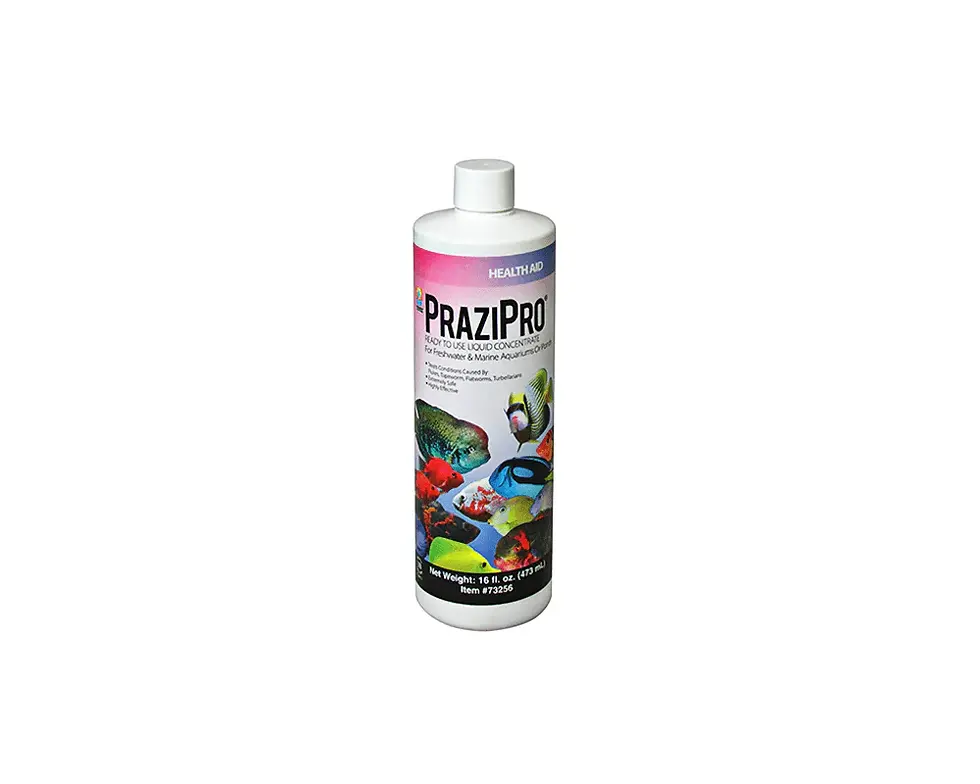
Hikari PraziPro (US / International)
A refined liquid formulation developed specifically for ornamental freshwater and marine fish, Hikari PraziPro is designed for the control of tapeworms, flatworms, and flukes.
Its fully solubilised Praziquantel base ensures even distribution throughout the aquarium, allowing systemic absorption through the gills and skin.
PraziPro’s gentle, plant- and invertebrate-safe formulation has made it a trusted choice for aquarists and professional breeders across the United States.
It is particularly valued for its ease of dosing, consistent dispersion, and compatibility with established biological filtration.
Active ingredient: Praziquantel - 5.0 mg per mL

eSHa gdex (UK / EU)
A specialised anti-helminthic formulated for ornamental freshwater fish, eSHa gdex is designed for the control of tapeworms, flatworms, and flukes.
Its praziquantel suspension disperses evenly in the water, supporting reliable uptake and consistent results when used as directed.
The drop-based dosing system offers simplicity and accuracy, which is especially helpful in small tanks where precise measurement matters.
Active ingredient: Praziquantel, 66 mg per mL
What to look for on the label
Before using any medication, check the label or product description carefully.
The active ingredient should be clearly stated
Avoid products that list multiple active ingredients
Be cautious of vague claims such as “treats all parasites” or “broad spectrum cure”
If the active ingredient is not clearly listed, it is best not to use the product
For worming aquarium fish, the active ingredient you need will be one of the following:
Levamisole hydrochloride for roundworms
Praziquantel for tapeworms and internal flukes
Ensuring safe and effective treatment
Successful worming depends not only on choosing the correct medication, but on providing stable conditions during treatment. Small adjustments make a meaningful difference to both effectiveness and fish safety.
Follow the instructions exactly
Medication concentrations can vary between products. Always follow the manufacturer’s dosing instructions precisely. Over or underdosing does not improve results and can cause unnecessary stress, especially in sensitive species such as pufferfish.
Reduce light and disable equipment that removes medication
Keep aquarium lighting off during treatment. Bright light can degrade some medications and increase stress in fish. Normal room light is sufficient for observation.
Remove chemical filtration media such as activated carbon or resins before dosing, as these will absorb medication from the water. Do not replace them until treatment and any follow-up water changes are complete.
Switch off UV sterilisers for the entire treatment period and leave them off for at least 24 hours after the final dose.
Maintain oxygen and a the stable temperature
Ensure strong surface agitation or additional aeration throughout treatment. Some medications slightly reduce dissolved oxygen, particularly in warmer water.
Keep the aquarium at its normal temperature. Do not raise temperature to “speed things up”. Stable conditions and good aeration are far safer and more effective.
Watch water quality
Worming agents can temporarily affect biological filtration. Test ammonia and nitrite daily during treatment and perform partial water changes if needed to keep both at zero. This is especially important in smaller or heavily stocked tanks.
Clean between doses
Many internal parasites release eggs or larvae into the environment. Vacuuming detritus and performing partial water changes between doses helps reduce reinfection and improves overall treatment success.
Observe your fish
It is normal for some fish to appear quieter or eat less briefly after treatment. This usually resolves on its own.
Signs of concern include persistent stress, rapid breathing, or erratic swimming. If these occur, perform an immediate partial water change and increase aeration.
What improvement looks like
Worming rarely brings dramatic, overnight changes. Internal parasites affect fish slowly, and recovery is usually just as gradual. This is normal, and it does not mean treatment has failed.
The first thing most keepers notice is stability. Fish continue eating, weight loss slows or stops, and overall condition begins to look more settled. Obvious improvement often comes later.
Visible changes usually take weeks rather than days. Gaining weight and condition depends on healing and consistent feeding, both of which take time. Slow progress is expected and is often a sign that things are moving in the right direction.
What matters most is not how fast improvement happens, but whether the trend is improving rather than worsening.
When it is worth pausing and reassessing?
Sometimes, improvement is not seen immediately.
It may be time to reassess if:
Weight loss continues after a full course and some recovery time
Overall condition continues to decline
The original pattern no longer seems to fit
Reassessing does not mean doing something immediately. Often it simply means giving the fish a little more time, or reviewing whether another cause might be involved.
Avoid the temptation to re-treat too soon
It is very common to want to “do something else” when results are slow. In most cases, this is not helpful. Repeating or adding treatments too quickly often causes more stress than benefit.
If your fish look stable and are slowly improving, patience is usually the best choice.
A reassuring reminder
Effective worming and bringing fish back into good health is about steady progress, not quick fixes. Stabilisation comes first, improvement follows, and time to heal and recover is part of the process.
When this guide may not be enough
This guide is designed to help with the most common internal parasite situations seen in aquarium fish. In most cases, following the approach outlined here is enough to reach a clear decision and a good outcome.
Occasionally, however, a situation falls outside what a beginner worming guide can reasonably cover.
It may be time to seek further advice if:
A fish continues to decline despite correct treatment and good conditions
Severe symptoms appear suddenly, rather than developing slowly
Breathing becomes persistently laboured or erratic
Multiple treatments have been used without any improvement
You are unsure whether parasites are involved at all
These situations do not mean you have done something wrong. They simply suggest that another cause may be involved, or that closer investigation is needed.
If you reach this point, our complete guide to worming pufferfish explores parasite biology, treatment logic, and reassessment in much greater depth. It is designed to build on the principles in this article and can help guide more complex decisions when things are unclear.
Author’s note
This guide was written because many keepers told us they wanted clear, responsible advice without being overwhelmed or rushed into treatment. Worming aquarium fish does not need to be dramatic or aggressive, and taking a measured approach is often the safest and most effective choice.
At PEW, we believe good fish care starts with observation, patience, and understanding rather than quick fixes. If this guide has helped you feel more confident and less pressured, then it has done exactly what it was meant to do.
Thank you for taking the time to read carefully and for putting your fish’s wellbeing first.
Disclaimer
This guide is intended for educational purposes only and reflects general best practice for aquarium fish care. It is not a substitute for professional veterinary advice.
Every aquarium is different, and fish health issues can have multiple causes. While the information provided here is based on current understanding and experience, outcomes can vary depending on species, environment, and individual circumstances.
Always read and follow the manufacturer’s instructions when using any medication. If a fish shows severe or rapidly worsening symptoms, or if you are unsure how to proceed, seek advice from a qualified aquatic veterinarian or experienced professional before continuing treatment.


Comments